
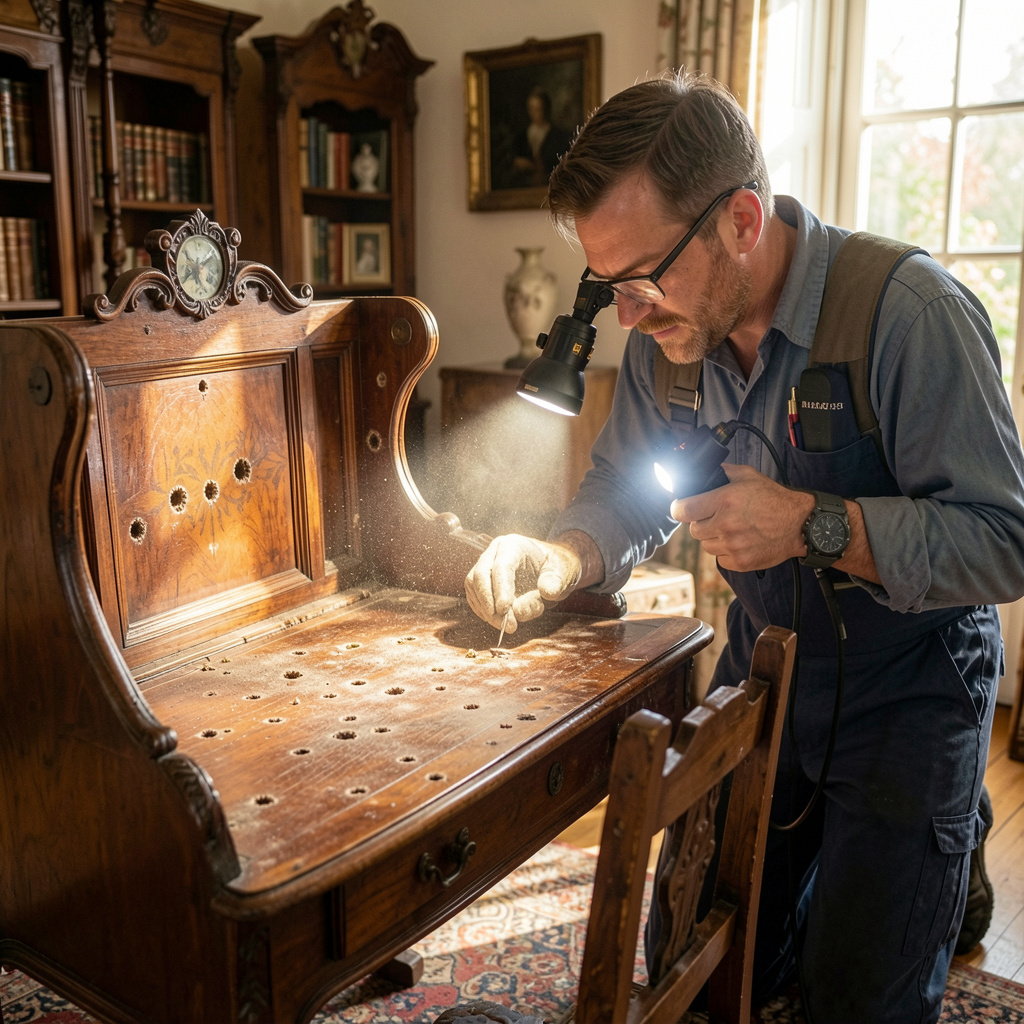
When people hear the word woodworm, they often imagine a tiny worm chewing through wooden furniture. In reality, woodworm is not a worm at all. The term refers to the larval stage of several species of wood-boring beetles that infest timber in homes, historic buildings, and furniture. Once these larvae complete their development, they transform into adult beetles, whose sole purpose is to reproduce and begin the life cycle again.
Understanding the anatomy of a woodworm beetle is more than just an interesting scientific topic—it can help homeowners identify infestations, distinguish woodworm from other timber pests, and better understand how these insects survive and spread. In this guide, we’ll explore the body structure of a woodworm beetle, explain the function of each body part, and discuss how its anatomy contributes to wood infestation.
What Is a Woodworm Beetle?
The term woodworm beetle refers to the adult stage of wood-boring beetles whose larvae feed inside timber. Common species found in European homes include:
- Common Furniture Beetle (Anobium punctatum)
- Deathwatch Beetle (Xestobium rufovillosum)
- House Longhorn Beetle (Hylotrupes bajulus)
- Powderpost Beetles (Lyctus species)
While the larvae are responsible for nearly all wood damage, adult beetles play a vital role by finding mates and laying eggs on suitable timber.
The Three Main Body Sections
Like all beetles, a woodworm beetle’s body is divided into three primary sections:
- Head
- Thorax
- Abdomen
Each section contains specialized structures that help the beetle survive and reproduce.
1. The Head
The head contains the beetle’s sensory organs and feeding structures.
Key features include:
- Eyes
- Antennae
- Mouthparts
Although adult woodworm beetles feed very little—or not at all in some species—they still possess functional mouthparts that help them emerge from timber and interact with their environment.
Compound Eyes
Woodworm beetles have compound eyes, which consist of many tiny lenses.
These eyes help the beetles:
- Detect movement
- Navigate their surroundings
- Locate mates
- Avoid predators
While their vision is not highly detailed, it is well suited to their short adult lifespan.
Antennae
The antennae are among the beetle’s most important sensory organs.
They detect:
- Chemical signals (pheromones)
- Moisture
- Suitable egg-laying sites
- Environmental changes
Different wood-boring beetle species have slightly different antenna shapes, which can aid in identification.
The Thorax
The thorax is the middle section of the beetle’s body and serves as the attachment point for the legs and wings.
It consists of three segments:
- Prothorax
- Mesothorax
- Metathorax
This part of the body provides the strength needed for walking and flight.
Six Legs
Like all insects, woodworm beetles have six jointed legs.
The legs allow them to:
- Walk across timber
- Climb rough surfaces
- Search for mates
- Explore suitable locations for laying eggs
Although they are capable of flight, beetles spend much of their adult life walking across wooden surfaces.
Wings
Adult woodworm beetles have two pairs of wings.
The front pair forms hard protective covers called elytra.
These hardened wing covers protect the delicate flying wings folded underneath.
During flight:
- The elytra lift upward.
- The transparent hind wings unfold.
- The beetle flies to locate mates or new timber.
After landing, the hind wings fold neatly beneath the protective covers.
Elytra: Nature’s Protective Armor
One of the defining features of all beetles is the elytra.
These hardened forewings:
- Protect the abdomen
- Shield the flying wings
- Prevent moisture loss
- Help defend against predators
The elytra give woodworm beetles their smooth, rounded appearance.
Their color ranges from light brown to dark brown or nearly black, depending on the species.
The Abdomen
The abdomen forms the rear portion of the beetle’s body.
It contains:
- Digestive organs
- Reproductive organs
- Respiratory openings
- Internal muscles
Although adult beetles live only a few weeks, the abdomen supports reproduction, which is the primary purpose of their adult life.
Respiratory System
Woodworm beetles do not breathe through lungs.
Instead, they use tiny openings along the sides of their body called spiracles.
These spiracles connect to an internal network of tubes known as the tracheal system, which delivers oxygen directly to body tissues.
This efficient system supports the beetle’s movement and short periods of flight.
Mouthparts
Adult beetles possess chewing mouthparts.
Unlike the larvae—which consume large amounts of wood—adult beetles rarely feed extensively.
Instead, their mouthparts are mainly used for:
- Emerging through timber
- Minor feeding (in some species)
- Grooming
The larval stage remains responsible for almost all timber damage.
Size and Appearance
Woodworm beetles vary in size depending on the species.
Typical measurements include:
| Beetle Species | Adult Size |
|---|---|
| Common Furniture Beetle | 2–5 mm |
| Deathwatch Beetle | 5–9 mm |
| Powderpost Beetle | 3–7 mm |
| House Longhorn Beetle | 8–25 mm |
Most species are:
- Brown
- Oval-shaped
- Hard-bodied
- Covered with fine hairs or smooth wing cases
Their small size often allows them to go unnoticed indoors.
How Anatomy Helps Woodworm Spread
The anatomy of the adult beetle is perfectly adapted for reproduction rather than feeding.
Its:
- Wings allow short-distance flight.
- Antennae locate suitable timber.
- Legs help explore wooden surfaces.
- Reproductive organs enable egg laying in cracks and crevices.
Once eggs are laid, the newly hatched larvae burrow into the timber and begin the destructive feeding stage.
How the Larva Differs from the Adult Beetle
Many people confuse woodworm larvae with the adult beetle, but they look very different.
Woodworm Larva
- Cream-colored
- Soft-bodied
- Curved shape
- Legless or with tiny legs
- Lives entirely inside wood
- Causes nearly all timber damage
Adult Beetle
- Brown or black
- Hard outer shell
- Six legs
- Two pairs of wings
- Emerges from wood
- Lives only a few weeks
Recognizing this difference helps homeowners understand why visible beetles are only a small part of the infestation.
Why Understanding Beetle Anatomy Matters
Knowing the anatomy of a woodworm beetle can help you:
- Identify infestations more accurately.
- Distinguish woodworm from termites and other pests.
- Understand the beetle’s life cycle.
- Recognize why larvae—not adults—cause structural damage.
- Appreciate the importance of early treatment before a new generation develops.
Preventing Woodworm Infestations
Although understanding beetle anatomy is useful, prevention remains the best defense.
Protect your timber by:
- Keeping wood dry.
- Improving ventilation.
- Repairing roof and plumbing leaks.
- Inspecting furniture regularly.
- Treating exposed timber with wood preservatives.
- Monitoring for exit holes and fresh frass.
Routine inspections can identify infestations before extensive damage occurs.
Conclusion
The anatomy of a woodworm beetle is perfectly adapted for one purpose: reproduction. While the adult beetle’s head, antennae, wings, legs, and protective elytra help it locate mates and suitable timber, it is the hidden larval stage that causes nearly all wood damage. Understanding the structure and behavior of these insects makes it easier to identify infestations, distinguish them from other timber pests, and take action before valuable furniture or structural beams are seriously weakened.
With regular inspections, proper moisture control, and prompt treatment when signs of woodworm appear, homeowners can effectively protect their timber and preserve the strength and beauty of wooden structures for years to come.Further Reading: https://www.shashel.eu official site for microwave woodworm treatment equipment.